
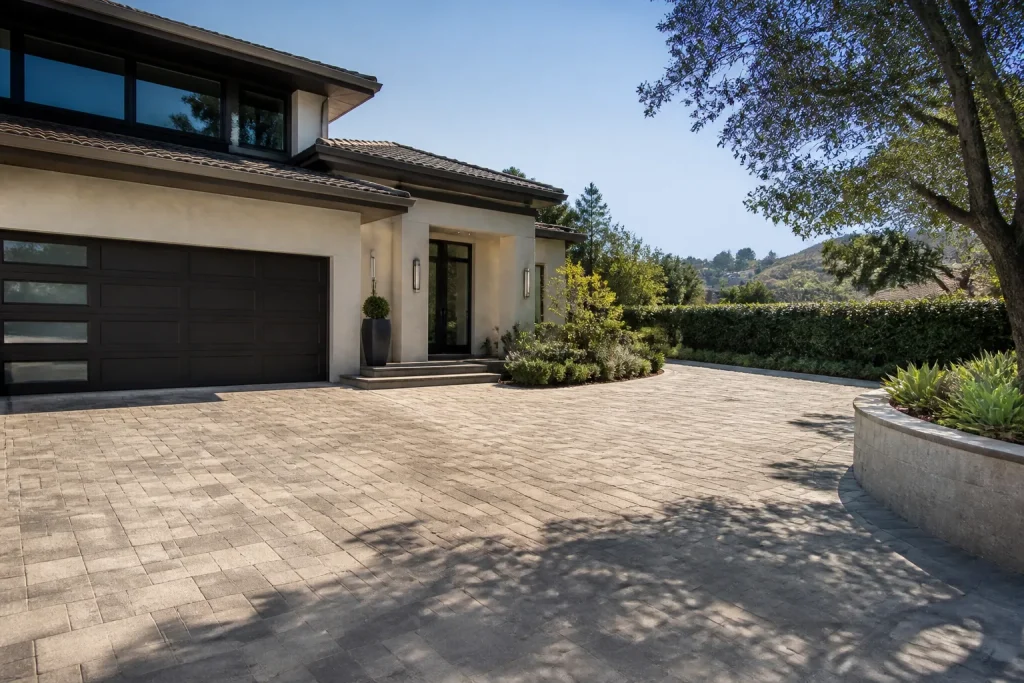
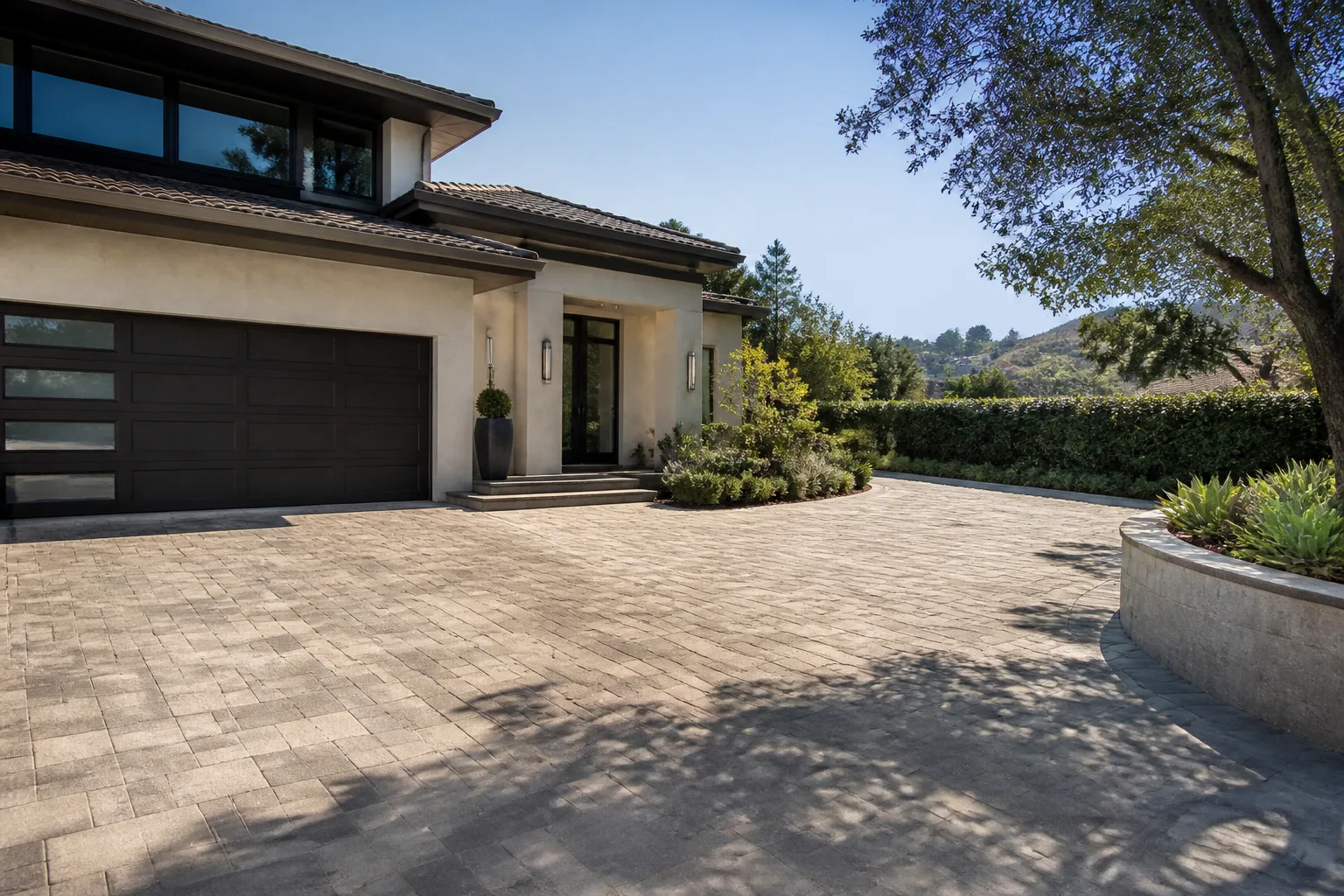
Cambria Driveway & Pavers in Los Angeles: A Homeowner’s Guide
Cambria’s surface looks bulletproof, but it’s the four inches of compacted base rock beneath it that determines whether that driveway looks the same in year seven as it did in year one. In Los Angeles, we’ve watched homeowners spend premium money on a Cambria driveway and skip the base prep, then call us two summers later when the whole thing has settled into a wavy mess. The brand on the stone doesn’t carry the job. The drainage and compaction underneath it do. This guide is about what a Cambria install in Los Angeles actually needs to hold up.
If you’d rather not sort through base depths and joint sand on your own, call (888) 427-1733 and we’ll walk your lot with you.
What Makes Cambria Different From Standard Concrete Pavers?
Cambria is natural quartz-based stone, not a cast concrete product. That distinction matters more in Los Angeles than almost anywhere else. We get intense UV year-round and big day-to-night temperature swings inland, and the two materials respond differently to both.
Manufactured concrete pavers are pressed and pigmented in a mold, so their color is consistent edge to edge and their flexural strength is engineered and predictable. Cambria’s stone is quarried and cut, which means natural variation in tone and density from piece to piece. Under Los Angeles sun, that variation is part of the appeal – it reads as real stone because it is. But natural quartz also behaves differently under thermal cycling. It expands and contracts with heat, and if the joints aren’t properly filled and the subgrade isn’t stable, that movement shows up as joint creep and edge chipping rather than the neat grid you see on day one.
The other difference is weight and bonding. Cambria pieces are dense. They don’t flex the way a thin concrete paver will, so they punish a soft base. A concrete paver laid over marginal subgrade might hold for years. A Cambria stone over the same base will telegraph every low spot.
We say this not to talk you out of Cambria. It’s genuinely one of the best-looking driveway materials you can put in front of a Los Angeles home. We say it so you budget for the base, not just the surface.
Why Drainage Design Is the Whole Ballgame on Los Angeles Sloped Lots
Los Angeles is not flat, and the neighborhoods where Cambria driveways show up most – Brentwood, Pacific Palisades, Silver Lake – are exactly where grade changes fastest. A driveway on a rolling inland lot and a driveway cut into a hillside in Silver Lake need completely different drainage plans.
Here’s what a properly specified Cambria install accounts for on a sloped Los Angeles lot:
- Cross-slope and fall. Water has to leave the driveway, not sit on it. We target a fall away from the garage and toward a defined low point, never toward the foundation.
- Base drainage. On hillside lots, the compacted base sits over native soil that wants to hold water. Without a drainage plane and a way for that water to escape, the base saturates and the stones pump.
- Channel drains and trench drains. Where a driveway meets a garage slab or a retaining wall, a linear drain is often the only thing keeping water out of the structure.
- Downspout tie-in. Roof runoff that dumps onto the driveway edge will undermine the base edge over time. It needs to route past the paving, not onto it.
- Permeable joint design. Cambria’s joints can be filled with a permeable aggregate so surface water drains between stones rather than sheet-flowing to one spot.
If a bid for a Cambria driveway on a Brentwood or Pacific Palisades slope doesn’t mention drainage at all, that’s your signal. A beautiful driveway that ponds water at the garage door is a problem, not a finish.
Which Cambria Lines and Finishes Hold Up Under Daily Driving?
Not every finish is built for a car. Cambria makes beautiful surfaces, and some of the most beautiful ones are meant for patios and walkways, not a daily-parked SUV. Here’s how we sort them.
High-traffic driveway use. Look for the denser, tighter-surface lines and finishes with a matte or honed texture. A honed surface gives grip under tire and foot traffic and hides the fine scuffs that a polished surface shows after a few months of Los Angeles sun and dust.
Decorative and low-use areas. The more dramatic polished and high-contrast finishes belong on a front walk, a courtyard, or a pool deck – places people walk but don’t park. On a driveway, polished Cambria looks stunning for the first year and then shows every tire mark.
Edges and thickness. For a driveway, you want a thickness rated for vehicular load and a consistent edge. Thin decorative stock belongs elsewhere.
We pair Cambria surfaces with trusted hardscape partners like Belgard and Unilock for borders, accent bands and retaining elements, so the driveway reads as designed rather than pieced together. Those accents also let you get the Cambria look where it counts and manage the budget on the surrounding hardscape.
Why Sealed Joints Matter – and What Happens If You Skip Year Two
Here’s the maintenance step almost everyone skips: joint sealing. Cambria’s joints need to stay filled and sealed, and on a Los Angeles driveway that means refreshing them roughly every two years.
What happens when that’s ignored:
- Joint sand washes out from irrigation overspray and winter rain, leaving open channels between stones.
- Water gets under the surface and into the base, softening the compaction that held everything tight.
- Stones shift and rock. First one corner, then a run. It’s slow, then it’s not.
- Edges chip. A loosened stone with an unsupported edge chips fast under a turning tire.
- Weeds move in. Open joints are a seedbed, and Los Angeles has no shortage of opportunistic growth.
A re-sand and re-seal is inexpensive compared to repulling stones and re-compacting base. Think of it as the oil change for your driveway. We build the sealing schedule into the handoff, and our 730-Day Done Right Promise covers the workmanship, so if a joint fails in the warranty window because of how we set it, we make it right.
What Does a Cambria Driveway Cost in Los Angeles?
Cambria driveways in Los Angeles run roughly $18 to $35 per square foot installed, with most residential driveways landing between $22 and $28 per square foot once base prep, drainage and sealing are included. A typical two-car Los Angeles driveway in the 500 to 700 square-foot range lands somewhere between $11,000 and $20,000.
| Line item | Typical Los Angeles range (per sq ft) |
|---|---|
| Cambria surface stone | $10 – $20 |
| Base prep and compaction | $3 – $6 |
| Drainage and grading work | $2 – $5 |
| Joint sand and sealing | $1 – $2 |
| Edge restraints, borders, accents | $2 – $4 |
The gap between a properly spec’d job and a price-matched shortcut usually shows up in two places: base depth and drainage. A shortcut bid lays Cambria over a thin, hasty base with no drainage planning, and it looks identical on the quote. It won’t look identical in year three.
Upfront pricing matters here. You should get a written line-item quote with base depth, drainage details and the sealing schedule spelled out, so nothing changes once the demo starts. Our free project estimate and design consult walks your actual lot so the number reflects your grade, not a square-foot guess.
When to Call a Pro
Cambria installs are heavy, precision work with real structural stakes. Base excavation on a Los Angeles slope, drainage design around a foundation, and cutting natural stone to fit a grade change are jobs for a trained crew with the right equipment. A poorly prepped base doesn’t fail safely – it fails under your car. This is the kind of work worth doing through a licensed and insured contractor who’ll put the spec in writing. Our technicians have up to 12 years of experience, and every job is backed by the 730-Day Done Right Promise.
Related services in Los Angeles: if you’re redoing the driveway, this is often the moment to pair it with a Fence Installation in Los Angeles to finish the front of the property, or plan ahead for a Home Additions & ADU in Los Angeles that changes how you use the drive and parking.
The Bottom Line
A Cambria driveway in Los Angeles is a premium choice that earns its price tag when the base, drainage and joints are specified correctly – and loses it when they’re not. The stone is the visible part. The 4-inch compacted base, the grade-appropriate drainage plan, and the two-year joint sealing schedule are what keep it looking right. Insist on a written line-item quote that names your base depth and drainage plan, and treat the sealing as a standing appointment.
If you’re in Los Angeles and want a clear read on what your lot needs, Groundwork Construction Co. of Los Angeles offers free estimates with upfront pricing and no surprises. We carry top-tier brand partners and back every job in writing. See our full scope at the Groundwork Construction Co. of Los Angeles home page, or dig into our Driveway & Pavers in Los Angeles service for more detail. Call (888) 427-1733 – a live person answers around the clock.
Frequently Asked Questions
Yes, if it’s installed over a properly compacted base with a drainage plan built for your lot. Cambria’s natural stone look is hard to match, and with joint sealing every two years it holds up well under Los Angeles UV and thermal cycling. The investment only pays off when the base prep and drainage are done right. Call (888) 427-1733 for a free estimate that spells out the base and drainage.
Expect roughly $18 to $35 per square foot installed, with most Los Angeles jobs landing between $22 and $28 per square foot once base, drainage and sealing are included. A typical 500 to 700 square-foot driveway runs about $11,000 to $20,000. Call (888) 427-1733 for an exact quote – estimates are free.
Every two years in most Los Angeles conditions, and more often on lots with heavy irrigation overspray. Skipping it lets joint sand wash out, water into the base, and stones shift. A quick re-sand and re-seal is far cheaper than repulling stones. Call (888) 427-1733 to schedule an assessment.
Yes, and sloped lots in Brentwood, Pacific Palisades and Silver Lake are where drainage design matters most. Fall has to route water away from the garage and foundation, and hillside base needs a drainage plane so it doesn’t saturate. Call (888) 427-1733 and we’ll walk your grade in person before quoting.
Written by the team at Groundwork Construction Co. of Los Angeles.
Need Construction Help?
Call Groundwork Construction Co. of Los Angeles - licensed & insured, here with fast after-hours help in Los Angeles.
(888) 427-1733