
5 Mistakes to Avoid With Driveway & Pavers
The five most expensive driveway paver mistakes in Los Angeles all happen before the first paver is laid. They’re planning, hiring, and specification decisions that look fine on paper and then show up as failures two to four years down the road, usually long after the contractor who made them has moved on. The most common one isn’t choosing the wrong material at all. It’s approving a base depth spec written for Arizona’s sandy soil, not the clay most Los Angeles driveways actually sit on.
We’ve watched this pattern repeat across enough jobs to know it isn’t bad luck. It’s predictable. Here are the five mistakes, in the order they tend to happen, with enough detail that you can spot each one before you sign anything.
Key Takeaways
- Base depth must be designed for LA’s expansive clay, not factory default specs.
- Drainage slope errors show up as pooling and heaving within two rainy seasons.
- Lowball quotes are usually missing line items that reappear as change orders.
- Several LA municipalities require permits for driveway replacement.
- The first 90 days after installation decide whether your warranty holds.
Mistake 1: Skipping the Soil Compaction Report
Most paver manufacturers publish base depth guidelines assuming a stable, well-draining subgrade. That assumption breaks down in much of Los Angeles, where expansive clay moves with moisture. Clay swells after a wet winter, shrinks through a dry summer, and keeps cycling. A base built to a generic spec can pass inspection on install day and still start shifting within a couple of seasons because nobody tested what was actually underneath it.
A soil compaction report tells you the bearing capacity of your subgrade and whether it needs over-excavation, lime treatment, or a geotextile layer before base rock goes down. Without it, your contractor is guessing based on what worked somewhere else. We routinely see this in older neighborhoods where decades of landscaping, irrigation leaks, and fill dirt have changed the soil profile from what the original lot looked like.
How to verify your contractor accounts for it:
- Ask whether they’ll test compaction before base installation. “We always do it right” isn’t an answer; a test or a documented procedure is.
- Request that base depth be specified in writing for your soil type, not quoted as a single number pulled from a manufacturer sheet.
- Confirm they compact in lifts, typically 2 to 4 inches at a time, rather than dumping and tamping one deep layer.
- Check that the compaction method and target density are written into the contract.
If a contractor can’t explain why your base depth is what it is, that’s the first sign to keep shopping.
Mistake 2: Underestimating Drainage Design
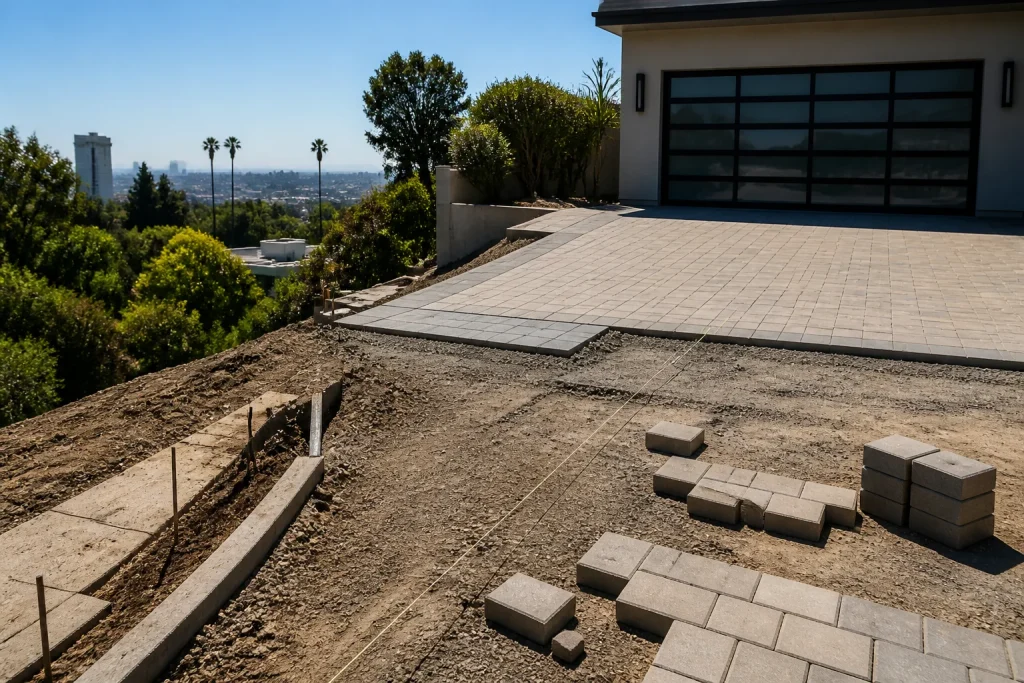
Los Angeles doesn’t get much rain, which is exactly why drainage gets skipped. When it does rain, it often arrives in concentrated bursts that overwhelm a driveway built flat or pitched toward the house. The failure chain is consistent: water pools at a low spot, saturates the base, softens the clay underneath, and the pavers heave or settle. Edges erode where runoff exits the pavement without a defined path. Within two rainy seasons you have a driveway that looks a decade older than it is.
Proper drainage design means a slope of at least 1 to 2 percent away from the structure, a defined exit point for runoff, and often a channel drain or gravel border to move water off the surface instead of letting it sit. On sloped lots, it also means checking where that water goes once it leaves your property so you’re not pushing a problem onto a neighbor.
We pulled up a driveway near the hills in Silver Lake where the original install had almost no pitch at all. Every storm sent water toward the garage slab. The pavers themselves were fine. The base was finished. The fix meant re-grading the entire pad, not just replacing the surface. That’s the kind of correction that costs far more than doing the slope right the first time.
Ask to see the drainage plan on paper before work starts. A confident contractor will walk the slope with you and point out every low spot and exit route.
Mistake 3: Hiring on Price Without Scope Verification
Low bids on paver driveways almost always come from a shorter scope, not a better deal. The missing line items tend to be the same ones: excavation and haul-away of old material, base rock depth, geotextile fabric, edge restraint, polymeric joint sand, compaction equipment rental, and permit fees. Each one is a real cost that has to land somewhere. When it isn’t in the bid, it reappears as a change order mid-project, usually after demolition has started and you’re not in a position to walk away.
Compare bids line by line, not by the number at the bottom. Ask each contractor to itemize:
- Excavation depth and disposal of removed material
- Base type and installed depth in inches
- Compaction method and number of lifts
- Edge restraint and joint sand specification
- Drainage components (channel drains, grading, exit points)
- Permit pull responsibility and fees
- Cleanup and haul-off
Two bids that differ by 30 percent are rarely quoting the same project. Sorting out which line items are missing takes ten minutes and can save you several thousand dollars. Upfront pricing on a written, itemized quote is the only version worth comparing.
When to call a pro
If you’re comparing bids and can’t tell which scope is complete, that’s the moment to bring in a second set of eyes. We walk homeowners through their quotes at no cost as part of a free estimate, and we’ll tell you which line items to ask about even if you hire someone else.
Related services in Los Angeles: Driveway & Pavers in Los Angeles covers installation scope and materials in more depth.
Mistake 4: Ignoring Permit Requirements
Permit rules for driveway replacement vary across Los Angeles County and its many municipalities. Some cities require a permit any time the paved area or impervious surface footprint changes, and several have stormwater and runoff requirements that kick in when you replace or expand hardscape. Others require a permit only if the work touches the public right-of-way at the driveway apron. The specific rules change by city, so “we’ve always done it this way” from a contractor is not a reliable guide.
Unpermitted driveway work carries consequences that show up years later:
- Insurance. A claim tied to a drainage or water intrusion issue near an unpermitted driveway can get complicated fast. Carriers ask for permits and inspection records.
- Resale. A buyer’s inspector will flag unpermitted hardscape. You may be required to permit it retroactively, or to remove and rebuild, before escrow closes.
- Code enforcement. A neighbor complaint about runoff or grading can trigger a city inspection of your property.
Before you sign, ask your contractor to confirm in writing whether your specific city or unincorporated area requires a permit for the scope you’re planning. If they can’t answer, call the local building department yourself. It takes one phone call.
Mistake 5: Skipping the Post-Installation Maintenance Window
The first 90 days after a paver driveway goes down determine whether the installation holds up long term. Joint sand settles as the surface takes its first traffic and its first rain. Edges need a check after the first storm to make sure runoff is going where it should. Weeds try to establish in any gap where sand has worked loose. None of this is heavy lifting, but it’s the homeowner’s job, and skipping it can void the workmanship warranty on many installations.
What the first 90 days require:
- Check and top off joint sand after the first rain, then again around the 60-day mark.
- Walk the perimeter and look for gaps in edge restraint or any paver that rocks underfoot.
- Look for pooling after each storm and photograph any low spots that don’t drain within a day.
- Pull weeds as soon as they appear rather than letting roots widen the joints.
- Keep a record of anything you find. Documented issues, reported early, are covered under a written workmanship guarantee. Ignored ones often aren’t.
Before you hire, ask what the maintenance window looks like in writing and what specifically voids the warranty. A contractor who hasn’t thought about this hasn’t thought about what happens after the job.
Our work on pavers falls under the 730-Day Done Right Promise – if it isn’t done right, we make it right, well past the window where most installers disappear. Our technicians have up to 12 years of experience, and we install with a curated brand line including Belgard pavers. For larger outdoor projects, homeowners often pair a driveway rebuild with Fence Installation in Los Angeles or plan a future Home Additions & ADU in Los Angeles so grading and drainage get designed once, not twice.
The Bottom Line
Every one of these five mistakes is preventable with questions asked before signing. Get the soil tested. See the drainage plan on paper. Compare bids line by line. Confirm permits in writing. Agree on the maintenance window up front. None of this costs extra at the planning stage, and each one saves real money down the line.
If you’re in Los Angeles and need help, Groundwork Construction Co. of Los Angeles home walks you through how we structure a project from first estimate to final walkthrough. Estimates are free and itemized, our pricing is upfront with no change-order surprises, and calls are answered by a live person 24/7. Call (888) 427-1733 for a free estimate and design consult. From foundation to finish line, every project is built to last and backed in writing.
Frequently Asked Questions
A paver driveway in Los Angeles typically runs $14 to $28 per square foot installed, and a standard two-car driveway (roughly 500 to 600 square feet) usually lands between $8,000 and $16,000 depending on paver type, base requirements, and drainage complexity. Clay-heavy lots and sloped properties land at the higher end because base and drainage work increases. Call (888) 427-1733 for an exact quote – estimates are free and itemized line by line.
It depends on your city or unincorporated area and on whether the paved footprint changes. Many LA municipalities require a permit when the impervious surface area increases or the work touches the public right-of-way at the apron, and some have separate stormwater requirements. Confirm with your local building department before work starts. A contractor who can’t tell you the rule for your zip code is a contractor to keep asking.
Heaving and settlement from an undersized base over expansive clay soil, usually worsened by poor drainage. The failure shows up 18 to 36 months after installation when the soil cycles through wet and dry seasons. It looks like a paver problem. It’s actually a base and drainage problem, and fixing it means re-doing both.
It shouldn’t if the original quote was itemized and complete. Price changes mid-project usually mean the original bid was missing excavation, haul-away, base depth, drainage components, or permit fees. Ask for a written scope before signing, and ask the contractor to confirm the quote will not change unless you change the scope. Call (888) 427-1733 and we’ll walk you through exactly what a complete quote includes for your project.
Written by the team at Groundwork Construction Co. of Los Angeles.
Need Construction Help?
Call Groundwork Construction Co. of Los Angeles - licensed & insured, here with fast after-hours help in Los Angeles.
(888) 427-1733