
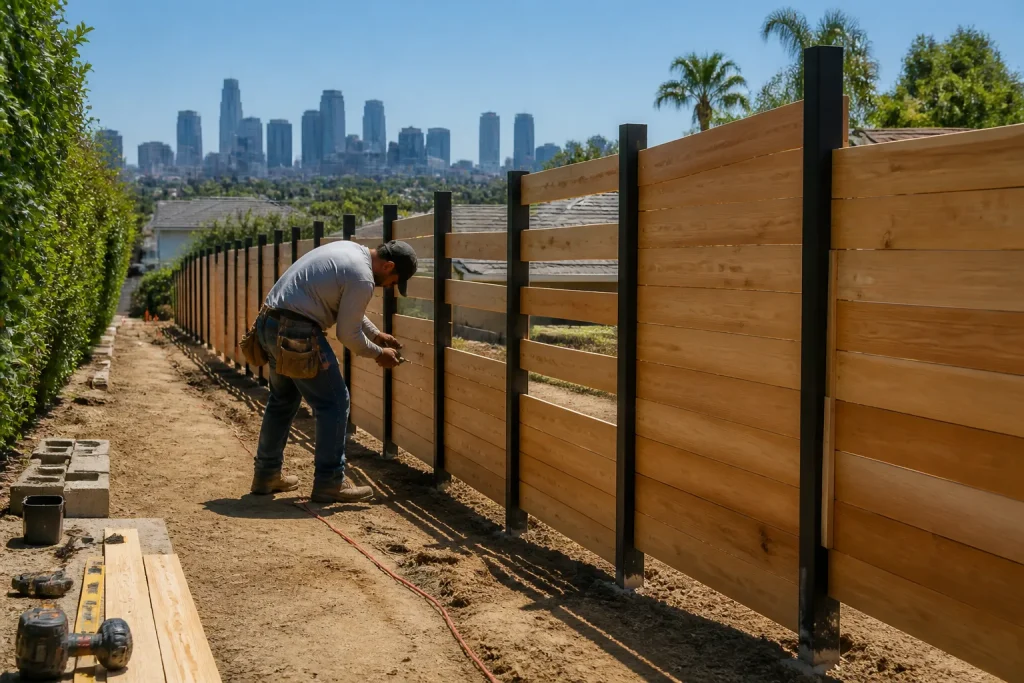
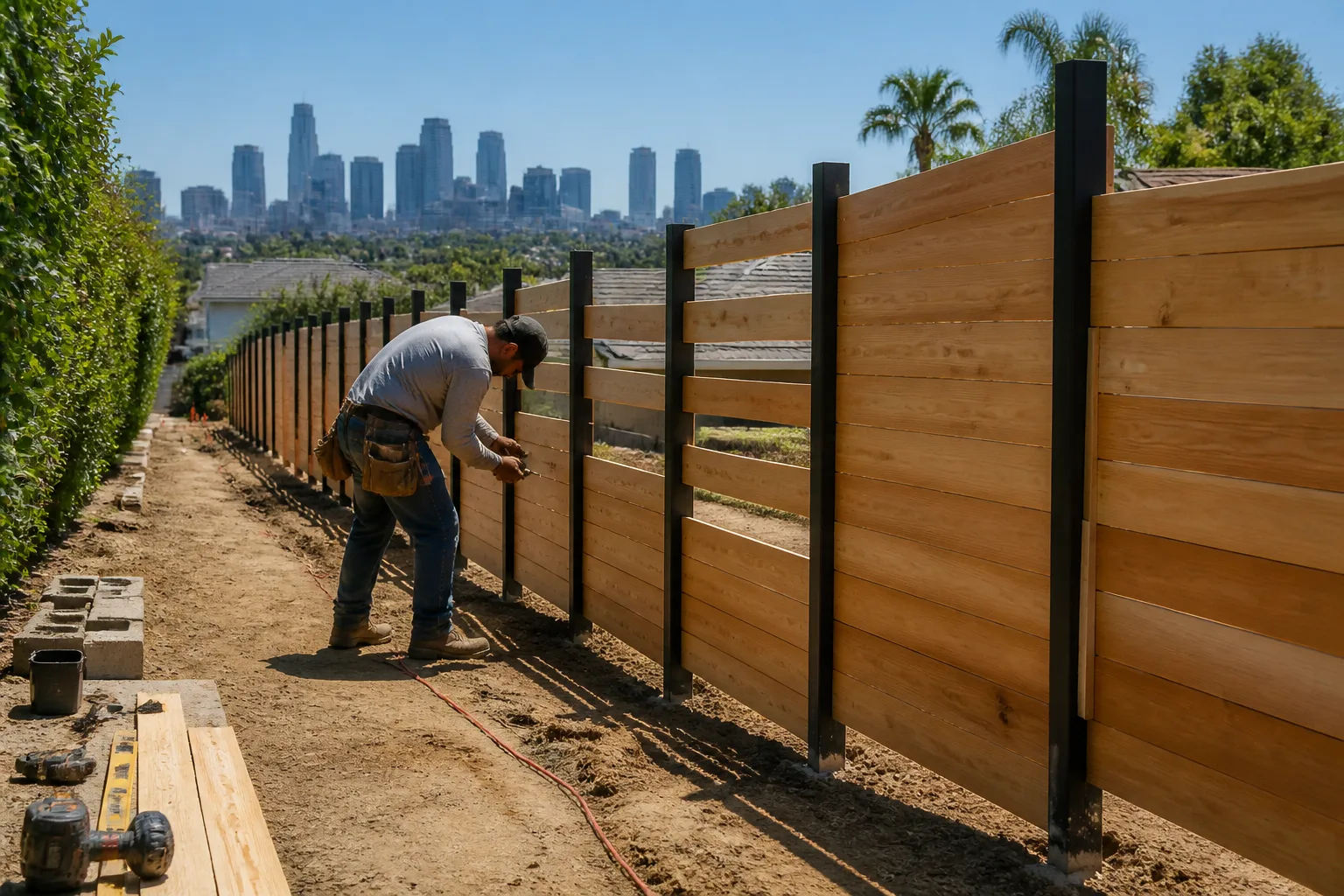
5 Mistakes to Avoid With Fence Installation
The number one fence installation mistake in Los Angeles isn’t hiring a bad contractor. It’s hiring a good contractor to install the wrong material for your microclimate, because nobody asked the right question before the first post went in. Most fence failures are decided in the first 48 hours of planning, long before a shovel touches dirt. Get those five decisions right and your fence stands for decades. Get them wrong and you’ll be paying twice. If you’d rather have someone who’s seen these failures for up to 12 years walk the property with you, call Groundwork Construction Co. of Los Angeles at (888) 427-1733 for a free estimate.
Key Takeaways
- Order a property line survey before you buy a single panel – LA fence disputes are legally expensive and hard to undo.
- Match the material to your microclimate: coastal, valley, and hillside Los Angeles properties demand different fences.
- Post depth and concrete footings must account for expansive clay soil and seismic movement.
- Check HOA rules and city height limits by neighborhood – they change block by block across LA County.
- The cheapest bid is usually missing proof of licensure, insurance, or a written labor warranty.
1. Skipping the Property Line Survey Before Installation
A fence built six inches onto your neighbor’s lot has to come back out. We’ve seen this play out in the hills above Silver Lake, where old lot lines run at angles nobody expects. The homeowner spent thousands on a custom fence, then spent more on a surveyor and a removal crew, then rebuilt it a foot to the left. It would have cost a fraction of that to get the survey first.
Los Angeles County parcels are frequently irregular. Lots platted decades ago don’t always match what’s recorded, and fences from a previous owner may already sit off the line. If you build on top of an error, you inherit it. A licensed surveyor confirms exactly where your boundary runs before any layout happens.
What a survey protects you from:
- Building on a neighbor’s property and being forced to remove the fence at your own cost.
- Inheriting a decades-old encroachment that becomes a legal problem when either home sells.
- Losing the setback you actually need for a retaining wall or hillside fence.
- A quiet title dispute that costs far more than the fence ever did.
In neighborhoods where fences run close to homes and driveways, the stakes climb. Tying a new fence to Driveway & Pavers in Los Angeles without confirming the property line is how a clean project turns into a boundary fight. Get the survey. It’s the cheapest insurance in the whole job.
2. Choosing Fence Material by Looks Instead of Microclimate
Los Angeles isn’t one climate. A fence that thrives in the San Fernando Valley can fail near the coast, and a hillside property in the Santa Monica Mountains asks different questions again. When a homeowner picks material from a photo without factoring in where the fence actually sits, the finish typically starts failing within a few seasons.
How the three microclimates differ:
- Coastal zones (Santa Monica, Venice, Pacific Palisades): salt air and marine moisture eat unprotected steel fast. Vinyl holds color well here, and powder-coated aluminum systems from ActiveYards resist rust far better than standard galvanized hardware. Wood needs regular sealing to survive the damp.
- Valley zones (Sherman Oaks, Woodland Hills, Northridge): summer heat swings and dry air crack cheap vinyl and warp untreated wood. Heat-rated composite and properly sealed cedar hold up.
- Hillside zones (Hollywood Hills, Mount Washington): intense sun, wind exposure, and grade changes. Here the fence often doubles as a retaining element, so material choice and engineering are linked.
This is where the opening hook bites. A good contractor installing the wrong material for the wrong microclimate still delivers a fence that fails on schedule. Ask what the material does in your specific conditions before you fall for how it looks. We’ll specify systems that hold up in your part of LA, and we back the installation with our 730-Day Done Right Promise so a workmanship issue doesn’t become your bill.
3. Getting Post Depth and Concrete Footings Wrong
LA’s expansive clay soils swell when wet and shrink when dry, and the region sits in a seismic zone. A post set 18 inches deep in a thin concrete plug can heave, lean, or snap within a couple of wet seasons. The fence looks fine the day the crew leaves. Two winters later it’s leaning into the neighbor’s yard.
What the footing actually needs:
- Posts set below the frost-free depth for the area, with deeper footings for taller or privacy fences.
- Footings sized to the post and soil condition, not a one-size hole reused across the whole line.
- Drainage handled so water doesn’t pool at the base of each post in clay soil.
- Bracing held until the concrete cures – rushed setting is how posts end up out of plumb.
The material choice interacts with this. Heavy privacy fence panels push harder on footings than open designs, and a hillside run may need engineered anchoring into grade. Brands like Belgard bring proven performance on the hardscape side, and matching that standard on the fence footings matters just as much. Skip the footing details and you’re buying a fence twice.
4. Ignoring HOA Rules and Varying Municipal Fence Codes
Los Angeles County fence rules shift block by block. An HOA in one neighborhood may cap fence height at 6 feet, while the adjacent city has a different limit. Some areas restrict material, some limit how close a solid fence can sit to a corner for sightlines, and hillside properties often face extra height scrutiny. Installing first and asking later means removing a finished fence.
Before you order materials:
- Confirm the height and material limits with your HOA in writing.
- Check the city or unincorporated-county code for your specific address, not the general LA rule.
- Note any front-yard, corner-lot, or sightline restrictions.
- For pool fences, confirm the safety barrier requirements before design.
If you’re planning additions down the road, line the fence up with that work. Tying the fence project into Home Additions & ADU in Los Angeles planning avoids rebuilding a fence you just installed because a new structure changed the setback. Getting it right the first time is the only version that saves money.
5. Taking the Lowest Bid Without Proof of License, Insurance, and Labor Warranty
The cheapest quote in Los Angeles is a bet that the contractor carries proper licensure, active liability insurance, and a written warranty on labor. When the number is dramatically lower than everyone else, one of those is usually missing. A fence that fails under warranty and has no paperwork behind it is your problem, not theirs.
What to demand from any bidder:
- Proof of a current contractor license for the scope of work.
- Certificate of active liability insurance and worker coverage.
- A written warranty that covers labor and workmanship, not just the material manufacturer’s warranty.
- A written scope with materials named and specifications listed.
This is where the written guarantee separates real value from a low number. Our 730-Day Done Right Promise means if it isn’t done right, we make it right – one of the longest workmanship guarantees in residential construction. On top of that, upfront pricing means the number you see is the number you pay, and 0% financing for 18 months plus $1,000 off projects over $10,000 keeps a large perimeter job within reach. The lowest bid isn’t always the cheapest once you count what it leaves out.
When to Call a Pro
Some fence work is genuinely a weekend project. But when the job involves a boundary that’s unclear, a hillside grade, a pool safety barrier, or a shared property line with a neighbor, the mistakes above get expensive fast. That’s the point to bring in a contractor who has done this for years in Los Angeles and will put the workmanship in writing.
Related services in Los Angeles: Fence Installation in Los Angeles for full-scope fence work, or start with our Groundwork Construction Co. of Los Angeles home page to see every trade we cover from foundation to finish line.
The Bottom Line
The five decisions that sink a fence project all happen in the planning hours, before the concrete is mixed. Get the survey, match material to your microclimate, nail down footing depth for LA’s clay and seismic conditions, clear the HOA and city code, and refuse a low bid that can’t show license, insurance, and a real labor warranty. Do those and your fence is a decade-proof investment instead of an annual repair bill.
If you’re in Los Angeles and need help getting it right the first time, Groundwork Construction Co. of Los Angeles offers free estimates. Our technicians bring up to 12 years of experience, arrive background-checked and in uniform, and every job is backed by the 730-Day Done Right Promise. Live person answers the phone 24/7, so you’re never stuck in a voicemail. Call (888) 427-1733 to schedule your free estimate.
Frequently Asked Questions
How much does fence installation cost in Los Angeles?
Fence installation in Los Angeles generally runs from roughly $35 to $90 per linear foot depending on material, height, and site conditions, with hillside footings and custom gates pushing toward the higher end. Coastal and hillside properties cost more because of footing engineering and material selection. Call (888) 427-1733 for an exact written quote – estimates are free.
Do I need a survey before installing a fence in Los Angeles?
Yes, you should get a property line survey before installation in most cases. LA County parcels are often irregular and old fences may already sit off the line, so building without confirming the boundary risks removal at your own cost. The survey is cheap compared to a boundary dispute.
Will the price change once work starts?
No. We provide upfront pricing, and the number you see is the number you pay. A line-item written quote covers materials, footing work, and labor so there are no surprise charges partway through the job. Call (888) 427-1733 to schedule your free estimate.
How long does a fence installation take in Los Angeles?
Most residential fence installs run two to five days depending on linear footage, material, and footing conditions. Hillside jobs and those requiring deeper footings for clay soils take longer. Call (888) 427-1733 and we’ll walk your property and give you a realistic timeline.
Written by the team at Groundwork Construction Co. of Los Angeles.
Need Construction Help?
Call Groundwork Construction Co. of Los Angeles - licensed & insured, here with fast after-hours help in Los Angeles.
(888) 427-1733