
Bathroom Remodeling: Repair or Replace? How Los Angeles Homeowners Decide
Most Los Angeles bathrooms that “look fine” are hiding something. A 1950s ranch in Van Nuys with original galvanized supply lines, a cast-iron drain at the end of its life, and a soft spot in the subfloor under a tile job that still cleans up nicely, that’s the typical picture. The honest answer: repair makes sense when the failure is isolated and the layout already works for your household. Replace makes sense when the problems are systemic. Below is how we walk Los Angeles homeowners through that decision, without the sales pressure.
If you’d rather have a professional look at it than guess, call (888) 427-1733. Estimates are free, and we’ll tell you plainly if a repair is the smarter money.
Why “Repair” Is Often the More Expensive Choice in Los Angeles
A repair fixes what you can see. In Los Angeles housing stock, the expensive failures are the ones you can’t. A surface tile patch on a 1962 bathroom with 60-year-old galvanized lines buys you two years, then you’re back in the same room with the same problem, minus the money you spent. We see this constantly in Mid-City and Echo Park, where the original baths survived because the tile was good, not because the plumbing was.
Here’s the framework we use to separate a real repair from a patch over a deeper problem:
- Is the failure isolated or systemic? One cracked tile, one loose fixture: repair. Cracked grout tracing a pattern across the floor, water pressure dropping at every fixture, drains that gurgle and slow: systemic.
- Does the layout already work? If you’re fighting a 5-foot tub you never use and a vanity with no storage, repairing preserves a room that’s failing your household every day.
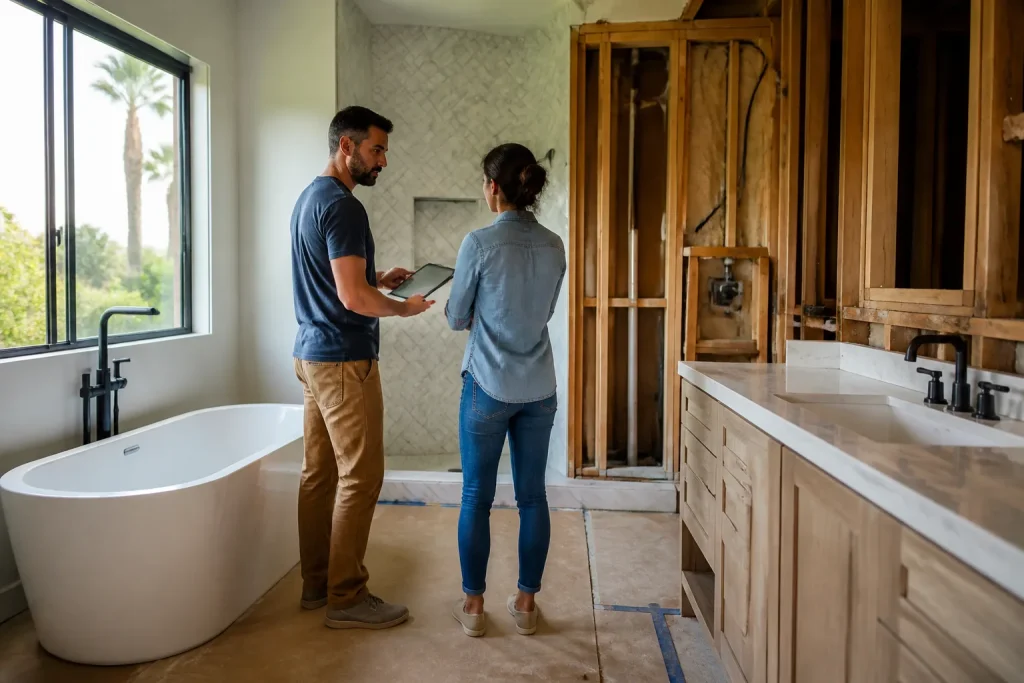
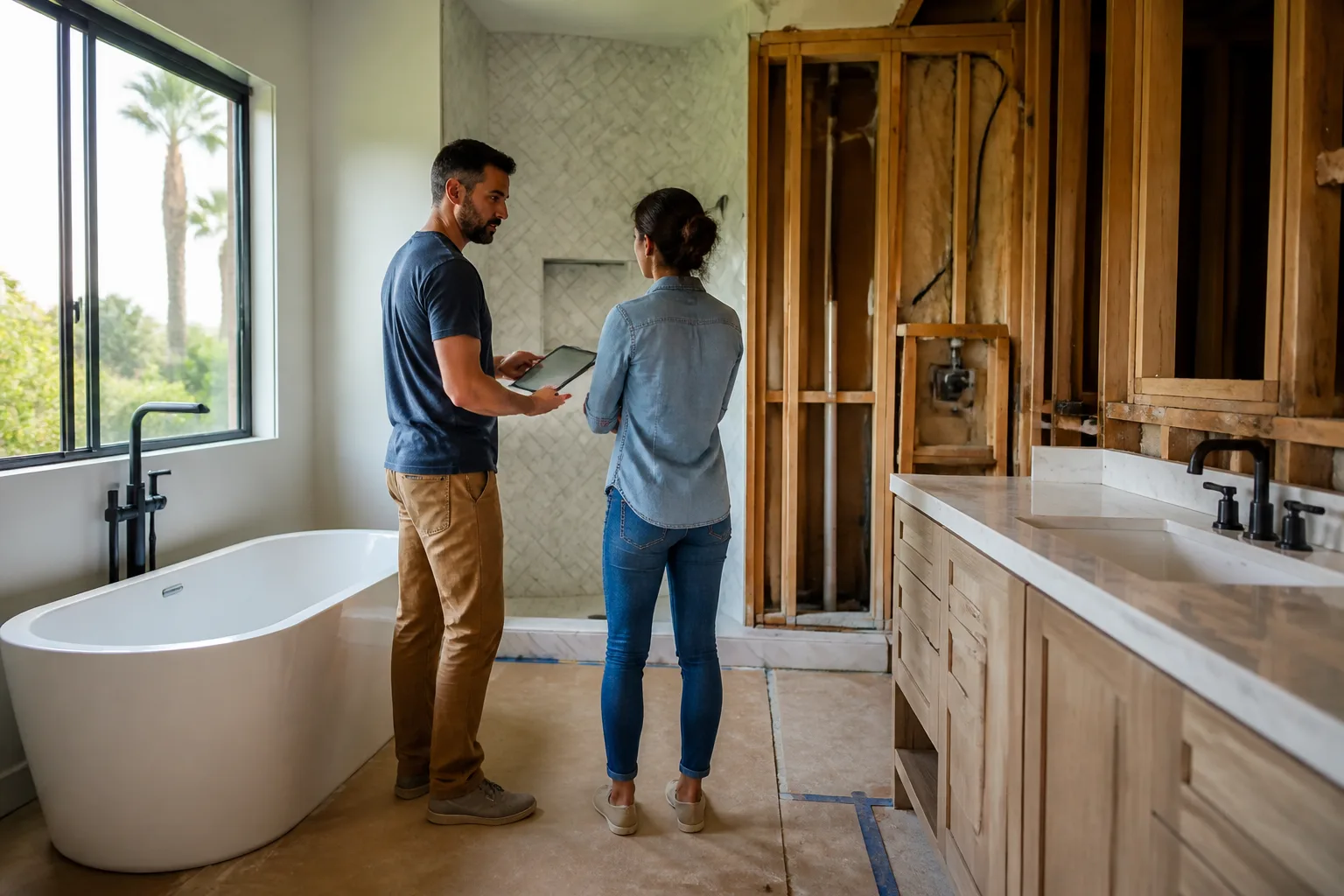
- What’s behind the wall? Galvanized supply lines and cast-iron drains past their service life mean any repair sits on borrowed time. Replacing the fixtures without touching the lines is money spent twice.
- What’s the moisture story? If there’s efflorescence (that white chalky bloom) on the tile or grout, water is moving through the assembly. That’s a wall-cavity problem, not a cosmetic one.
Run those four questions honestly and most Los Angeles homeowners land on the same answer: repair only when the infrastructure is sound and the layout already fits.
The Hidden Infrastructure Signals That Say “Replace,” Not “Repair”
Bathrooms announce systemic failure long before they visibly fail. The signals are subtle, and they’re the reason a repair that looked reasonable in month one feels like a mistake by year three. In our experience across Los Angeles, these are the ones that matter most:
- Water pressure that drops at every fixture over time. On galvanized lines, that’s internal corrosion scaling the pipe shut. A new showerhead won’t fix it.
- Drains that slow no matter what you snake through them. Cast-iron drains roughen and collect waste on the interior wall. Snaking clears the center, not the buildup.
- Grout cracking in a repeating pattern. Cracks that follow the floor joists usually mean deflection, a subfloor that’s flexing underfoot. Tile repairs will keep failing until the substrate is addressed.
- Efflorescence on tile or grout. White mineral bloom means water is migrating through the assembly. That’s a moisture problem behind the tile, not on it.
- A faint musty smell that never quite leaves. Often wall-cavity moisture you can’t see, and the reason a “cosmetic” repair keeps coming back.
Any two of these together in a Los Angeles bathroom is the point where we stop talking repair and start talking scope.
Los Angeles Water Damage: Why Surface Repairs Miss the Real Problem
Los Angeles has an unusual moisture profile. Long dry stretches bake the exterior, then the wet season arrives and water finds every gap in a 60-year-old assembly. Old building stock in neighborhoods like Highland Park and Boyle Heights was framed before modern waterproofing standards, often with minimal vapor management. The result is subfloor and wall-cavity moisture that a surface tile repair never touches.
What that looks like in practice: a bathroom that reads dry on the surface, passes the hand test, and still has a soft subfloor around the toilet flange or a swollen base plate behind the tub. We pulled a vanity out of a house near Silver Lake last spring and found the subfloor had been quietly rotting under a tile job that looked fine from standing height. Nobody had done anything wrong. The moisture had simply been working for decades.
Surface repairs treat the symptom. If there’s any sign of moisture in the assembly, the fix is opening the room up, addressing the waterproofing, the substrate, and the ventilation, and rebuilding it correctly. That’s a full scope, and it’s the honest one.
ROI by Neighborhood: The Math Is Different in Silver Lake, the South Bay, and the Valley
A bathroom remodel pays back differently depending on where in Los Angeles the house sits. The national “recoup X% at resale” figure is not a Los Angeles figure. Here’s how we think about it by tier:
- Silver Lake, Los Feliz, Echo Park: Buyers in this tier pay a premium for a bathroom that reads original-but-updated. A well-executed remodel with period-appropriate tile and quality fixtures tends to return strongly at resale because it fits what the neighborhood expects. Cheap finishes hurt you here.
- South Bay (Manhattan Beach, Redondo, Torrance): The buyer pool is broader and the price-per-square-foot is high. A full remodel that opens up a cramped original bath and adds usable storage tends to perform well. Repair-only reads as deferred maintenance to this buyer pool.
- The Valley (Van Nuys, Northridge, Reseda): Home values and remodel budgets are lower, so the ROI math favors a tighter scope. Focus on the infrastructure (the plumbing, the waterproofing, the ventilation) and skip the luxury finishes. The repair-versus-replace call here is more often “replace the systems, keep the finishes modest.”
The pattern: in higher-value Los Angeles tiers, a full remodel is a value play. In the Valley, it’s a livability play, and getting the scope right matters more than the finish level.
When a Repair Triggers Code Compliance and the Full Scope Becomes Unavoidable
This is the part most Los Angeles homeowners don’t see coming. A repair that pulls a permit can trigger current code requirements the original 1960s bathroom never met. Once you’re in the wall, the inspector looks at what’s there, and suddenly a “small” repair is a full scope anyway.
- Ventilation: Current code requires mechanical exhaust vented to the exterior on bathrooms without an operable window. Older baths often vent into the attic.
- GFCI protection: Receptacles near water require ground-fault protection. Original bathrooms often have none.
- ADA-adjacent clearances: Not always required in a single-family remodel, but grab-bar backing, clearances at the toilet and shower, and reachable controls come up often enough that planning for them now saves a redo later.
- Waterproofing standards: Current standards for shower assemblies and wet-area substrates are stricter than what was common when the house was built.
The practical takeaway: if a repair requires opening the wall, price the full scope at the same time. In Los Angeles, the difference between a permitted repair and a full remodel is often smaller than the change-order surprise waiting on the other side.
How to Structure the Contractor Conversation (and Avoid Change-Order Roulette)
The repair-versus-replace decision is half the battle. The other half is making sure the project you sign is the project you get, at the price you agreed to. Here’s what we tell Los Angeles homeowners to ask for on any bathroom project, repair or full remodel:
- A written scope, line by line. Every item, every allowance, in writing. If it’s not on the page, it’s not in the price.
- Material selections with manufacturer warranties attached. We work with brands like Kohler because the warranty is real and the parts are available. The selection isn’t a marketing decision, it’s a repair-someday decision.
- A fixed-price contract. The number you sign is the number you pay. Change orders only if you change the scope, not because the contractor missed something.
- A written workmanship guarantee. Ours is the 730-Day Done Right Promise: if it’s not done right, we make it right. Ask any contractor what happens in year two if a tile fails or a shower pan leaks.
- Permits pulled and inspections passed. Ask who pulls the permit. If the answer is you, that’s a problem.
When the work is on your roof, your fence, or your driveway, the same discipline applies. If you’re considering other projects while the bathroom is open, we’ve written separately about Driveway & Pavers in Los Angeles and Fence Installation in Los Angeles, and both follow the same fixed-price, written-scope approach. Bathrooms are just the room where deferred decisions get expensive fastest.
When to Call a Pro
If you’ve spotted two or more of the systemic signals above, or if you’re unsure whether the moisture you’re seeing is surface or structural, get a professional assessment before you spend on a repair. Water damage behind tile is the one thing a homeowner can’t reliably diagnose by hand. The cost of a walkthrough is zero, and the cost of repairing the wrong thing is real.
For a broader look at how we handle full-scope projects, from a single bath to a full home addition, see our Groundwork Construction Co. of Los Angeles home page and our work on Home Additions & ADU in Los Angeles.
The Bottom Line
In Los Angeles, the repair-versus-replace decision isn’t about whether the tile looks good. It’s about what’s under the tile. Repair the surface when the infrastructure is sound and the layout already works for your household. Replace when the plumbing, drain, or subfloor is past its service life, or when a permitted repair triggers code upgrades that make the full scope unavoidable. The ROI math favors a full remodel in higher-value tiers and a systems-first scope in the Valley. Whatever you choose, demand a written scope, a fixed price, and a workmanship guarantee in writing.
If you’re in Los Angeles and want a straight answer on your bathroom, Groundwork Construction Co. of Los Angeles offers free estimates. Call (888) 427-1733, and a live person will pick up, day or night. The number you see is the number you pay. Our technicians have up to 12 years of experience, and every project is backed by our 730-Day Done Right Promise.
Frequently Asked Questions
A full bathroom remodel in Los Angeles typically runs $18,000 – $45,000 depending on scope, tier, and finishes. A smaller in-kind replacement runs $12,000 – $22,000, and a repair-only scope can be $1,500 – $6,000. The range is wide because the biggest variable isn’t finish level, it’s what’s behind the wall. Call (888) 427-1733 for an exact quote, estimates are free.
You need a full remodel when the failure is systemic: galvanized supply lines, cast-iron drains past their life, moisture in the subfloor or wall cavity, or a layout that no longer fits your household. Isolated failures like a single cracked tile or a leaky faucet are repair territory. Two or more systemic signals together usually means replace. Call (888) 427-1733 and we’ll walk the room with you at no cost.
Not on our projects. We work from a written line-item scope and a fixed-price contract. The number you sign is the number you pay, and change orders only happen if you change the scope. Call (888) 427-1733 for a written estimate before you commit to anything.
Yes. We pull the permits and we pass the inspections, and we handle the code compliance items like mechanical ventilation and GFCI protection that a permitted scope triggers. Call (888) 427-1733 to schedule your free estimate and we’ll walk you through what your specific project requires.
Written by the team at Groundwork Construction Co. of Los Angeles.
Need Construction Help?
Call Groundwork Construction Co. of Los Angeles - licensed & insured, here with fast after-hours help in Los Angeles.
(888) 427-1733