
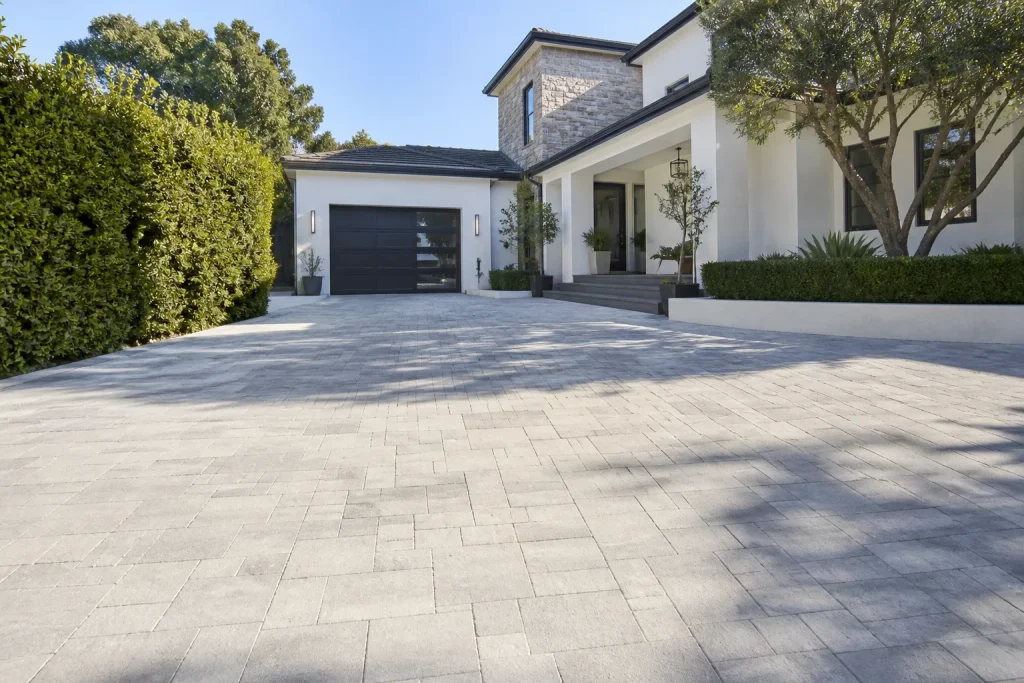
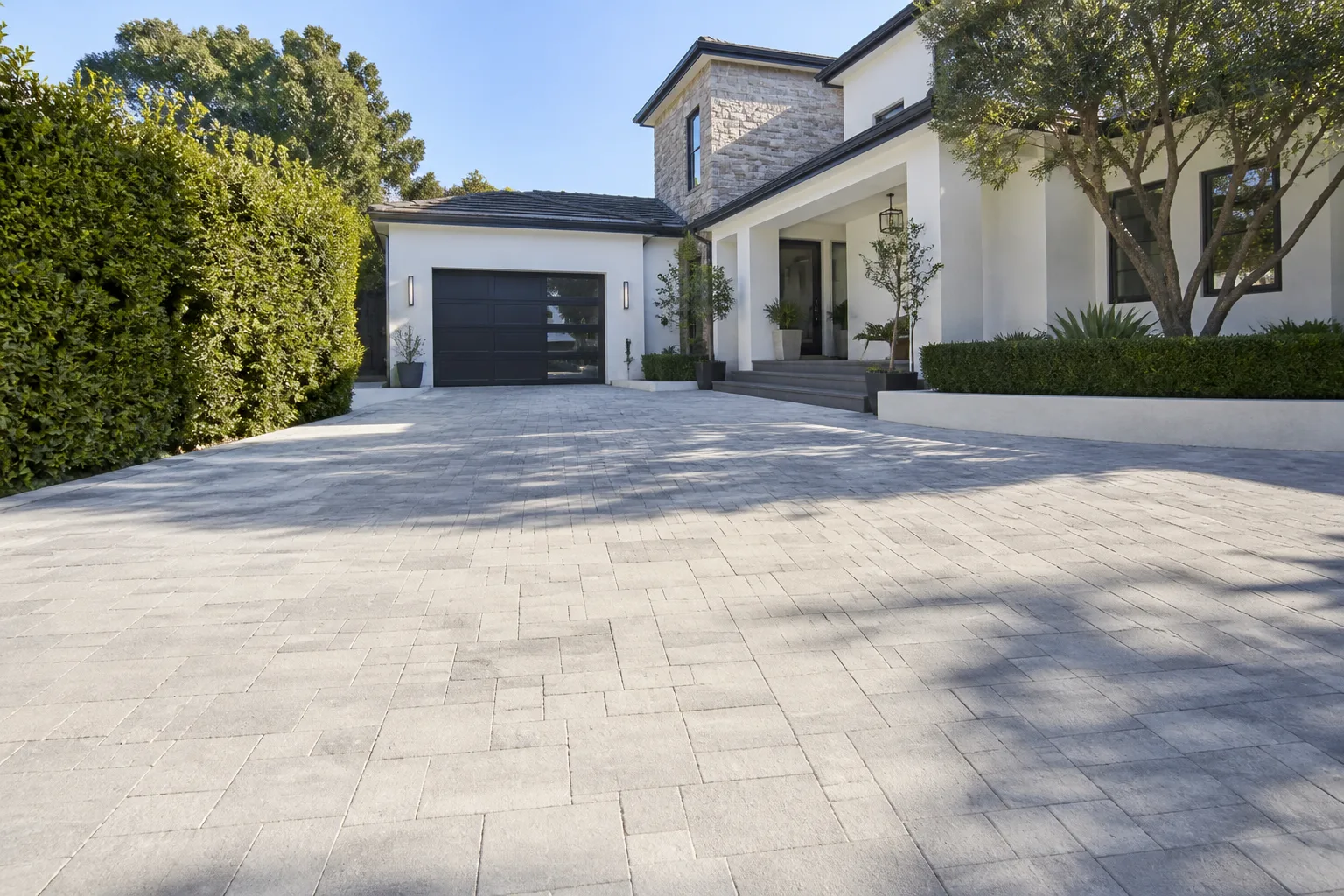
Blanco Driveway & Pavers in Los Angeles: A Homeowner’s Guide
If you searched “Blanco driveway pavers,” you’ve been told by someone – or something – that the brand is relevant to your project, and that’s worth examining before it costs you a slab decision you’ll live with for 20 years. Here’s the short answer: Blanco doesn’t make driveway pavers. Blanco is a German manufacturer of kitchen sinks and faucets. It’s exceptional at that, and completely absent from the hardscape category. So this guide does something more useful than selling you a paver. It shows you how to evaluate hardscape materials the way a builder does – on spec sheets, load ratings, and climate fit – rather than on brand names you recognize from your kitchen.
Los Angeles driveways are a specific animal. UV load, thermal swing, and clay soil that moves with the seasons will punish a material chosen for looks alone. If you’d rather have a pro read the specs with you, call (888) 427-1733 for a free estimate.
Key Takeaways
- Blanco makes kitchen sinks and faucets, not pavers. Any contractor who tells you otherwise is confused or improvising.
- Driveway pavers need to be judged on compressive strength, water absorption, and thermal performance – not brand familiarity.
- Los Angeles homes sit in a mild, mostly frost-free climate, so UV resistance and thermal expansion matter far more than freeze-thaw ratings.
- Ask for the material data sheet, the manufacturer warranty, and a load rating before any paver goes down.
- Decorative stone belongs on accent paving. A driveway is structural and needs a structural-grade system underneath it.
Where Blanco Actually Belongs in a Los Angeles Home
Blanco’s legitimate territory is the kitchen. The company makes undermount sinks, workstation sinks, and faucets that have earned a real reputation among designers and remodelers. If you’re planning a kitchen update in Los Angeles – a Pasadena bungalow, a Culver City ranch, a Mid-City Craftsman – Blanco is a name that belongs in that conversation alongside brands like Kohler and KraftMaid.
Here’s where the confusion usually starts. Modern search engines will happily mash a premium kitchen brand onto a hardscape query because both feel “home improvement.” That’s how a homeowner ends up asking about Blanco pavers, or Barrette driveways, or Ameristar stone. In our experience, it happens most with brands that already earned trust in one room of the house.
So placement matters:
- Kitchen and prep areas: Blanco sinks and faucets, Kohler fixtures, KraftMaid cabinetry. This is where those names earn their reputation.
- Decorative hardscape accents: Landscape stone, boulevard borders, garden paths. Feels similar, but it’s a different product category entirely.
- Driveway surfaces: Structural paver systems from manufacturers who publish load ratings and warranty documentation. Brands like Belgard belong here.
Mixing those categories isn’t a small mistake. It’s the difference between a slab that holds up for two decades and one that heaves, cracks, or spalls in year four.
What Actually Matters in a Los Angeles Driveway Material
Los Angeles is not a harsh climate in the way Chicago or Minneapolis is. We rarely see a deep freeze, which means the freeze-thaw rating every national paver brochure leads with is mostly irrelevant here. What does matter is different, and it’s where a lot of southern California driveways fail.
Here’s the shortlist of specs we read first:
- Compressive strength. Measured in PSI or MPa. For a residential driveway taking daily car traffic, you want the manufacturer to publish a number, not a vague “heavy-duty” label.
- Water absorption. Lower absorption means less staining, less efflorescence, and less risk of spalling under UV load. Look for the percentage on the data sheet.
- Thermal expansion coefficient. LA pavement goes from cool mornings to 90-degree afternoons. Materials with high expansion and no joint planning will move and crack.
- UV color stability. Our sun is relentless. Any paver that isn’t rated for UV colorfastness will fade, chalk, or shift tone within a few years. This is one of the biggest differences between premium and discount hardscape.
- Abrasion resistance. A driveway takes tire scrub, garden grit, and the occasional dropped tool. The data sheet should list this.
Notice what’s missing. Nobody on the spec sheet says “trusted brand.” The spec sheet is what tells us whether the material belongs in a Los Angeles driveway, and it’s what we’d hand a homeowner before finalizing a paver selection.
How to Read a Paver Data Sheet: A Builder’s Method
When a manufacturer publishes a proper data sheet, it usually covers the same handful of sections. Here’s how we walk a homeowner through it in Los Angeles, in plain English.
- Physical properties table. Look for compressive strength, water absorption, and flexural strength. If any of those three are missing, ask why before moving forward.
- Dimensional tolerance. Pavers that measure inconsistently cause wider joints, uneven sand lines, and a driveway that never quite reads flat. Tolerance is listed in millimeters – the tighter the better.
- ASTM or equivalent test reference. A data sheet without a test standard is a marketing sheet. We want to see what standard the number was measured against.
- Warranty terms. Not the headline, the fine print. What’s the covered period, what voids it, and is it a full system warranty or just a product warranty?
- Installation requirements. Bedding depth, base depth, joint sand specs, edge restraint. A paver that demands a strict install is only as good as the crew following that requirement.
Here’s a real-job moment from our side of the fence. We pulled one out of a driveway in Northridge last spring where the pavers themselves were fine – good compressive strength, solid absorption numbers – but the base had been laid at half the specified depth. The slabs were premium. The failure wasn’t the material. It was the install behind it. That’s why the data sheet matters, and so does the crew reading it.
Decorative Stone vs. Structural Paver Systems: A Real Difference
The single biggest driver of a failed Los Angeles driveway we see isn’t the wrong brand. It’s the wrong category of product. Decorative stone surfaces and structural paver systems are not the same thing, and they shouldn’t be swapped.
Decorative stone is what you’d see on a garden path, a front walkway border, or a landscape accent. It’s often thinner, sometimes irregular, and specified for foot traffic or visual treatment. It’s beautiful, and it has a place on plenty of Los Angeles properties.
A structural driveway-grade paver system is engineered for vehicle loads. That means:
- A thicker paver – typically a specified nominal thickness the manufacturer ties to load rating.
- A compacted aggregate base sized to the driveway’s vehicle weight and soil conditions.
- Edge restraints that prevent lateral movement under tire load.
- Polymeric or specified joint sand that holds the system together.
- A manufacturer warranty that specifically covers vehicle traffic.
National brands like Belgard publish structural systems rated for driveways. What they don’t publish is anything about Blanco, because Blanco isn’t in this category. Anyone handing you a decorative product and calling it driveway-grade hasn’t read the sheet – which means they haven’t read your soil either.
Red Flags When a Contractor Recommends a Material
Los Angeles has a lot of contractors and a wide range of quality. We’ve spent enough time behind other crews’ work to know the warning signs, and they tend to cluster around the same behaviors. If your contractor does any of the following, slow down.
- No spec sheet, no exception. If they can’t produce a manufacturer data sheet for the pavers they’re proposing, they either didn’t get one from their supplier or didn’t look. Either way, it’s a problem.
- No load rating. A driveway has vehicles on it. If the proposal doesn’t reference how the system handles that load, it’s not a driveway system – it’s a decorative install without a plan.
- No manufacturer warranty documentation. Verbal warranty promises are worthless once the check clears. Ask for the written warranty on the paver line itself.
- Brand confusion as expertise. If a contractor tells you a kitchen brand makes excellent pavers, they’re improvising. That’s not cynicism – it’s a signal to ask harder questions about everything else too.
- Vague pricing. If the bids don’t itemize materials, base prep, excavation, and edge restraints separately, you can’t compare them. Vague bids invite change orders later.
There’s a simpler version of all this: if your contractor can’t show you a data sheet, they didn’t read the sheet. Ask them to. A good one will pull it up before the end of the meeting.
When to Call a Pro
Not every paver project needs a full crew, but a few situations do, and getting them wrong is expensive to undo.
- Excavation and base prep. Los Angeles clay soil, especially around the Valley and near the hills, behaves differently from one block to the next. Base depth isn’t a guess.
- Drainage grading. A driveway that sheets water toward your garage slab or foundation is a slow-motion problem. Getting the slope right is a pro’s job.
- Full driveway replacement. Removing an existing slab, evaluating subgrade, and rebuilding correctly is a multi-day scope, not a weekend.
- Structural paver systems where the warranty depends on installation to spec. A voided warranty is more expensive than a slightly higher install bid.
Our own approach leans on manufacturers who stand behind their materials in writing – Belgard for hardscape, brands like Barrette and Master Halco when a driveway tie-in touches gate or fence work. Every project we take on is backed by our 730-Day Done Right Promise, and estimates come with itemized, upfront pricing so you’re comparing apples to apples.
Related services in Los Angeles: if the driveway job is part of a bigger exterior plan, you may be looking at Driveway & Pavers in Los Angeles or our Fence Installation in Los Angeles page. For homeowners planning a bigger scope across the property, our Home Additions & ADU in Los Angeles page covers how hardscape, drainage, and sitework tie into larger builds. Start from the Groundwork Construction Co. of Los Angeles home page if you’re mapping the whole project.
The Bottom Line
Blanco doesn’t belong in your driveway. It belongs in your kitchen. If a search result or a contractor told you otherwise, you now have the answer. More importantly, you have a method: ask for the data sheet, match the specs to Los Angeles conditions, and confirm that the material you’re buying is rated for vehicle load rather than foot traffic. The brand name matters far less than the load rating printed on page two of the manufacturer documentation.
If you’re in Los Angeles and need help sorting out a driveway or paver project – including evaluating whether the material your contractor proposed actually belongs on your property – Groundwork Construction Co. of Los Angeles offers free estimates. Call (888) 427-1733. We answer with a live person, day or night, and we walk into the estimate with the specs on the table.
Frequently Asked Questions
No. Blanco makes kitchen sinks and faucets – excellent ones – and does not manufacture driveway pavers or any hardscape material. Any recommendation of Blanco for a Los Angeles driveway is a category error worth questioning. Call (888) 427-1733 for a straight answer on which brands actually belong on your driveway.
The specs that matter most in Los Angeles are compressive strength, water absorption, UV color stability, and thermal expansion – not freeze-thaw ratings, since LA rarely freezes. Ask your contractor for the manufacturer data sheet so you can compare those numbers. Our team can walk you through the sheet during a free estimate; call (888) 427-1733.
Check the manufacturer warranty and load rating. Structural driveway-grade pavers are sold as a system with a specified base depth, edge restraint, and warranty that covers vehicle traffic – decorative stone is generally not. If the documentation doesn’t reference vehicle load, it’s decorative. Call (888) 427-1733 if you want a second read on a proposed material.
Ask three things: can I see the material data sheet, what’s the load rating, and where’s the written manufacturer warranty. Any Los Angeles contractor who can’t answer those before work starts is a red flag. Groundwork Construction Co. of Los Angeles provides itemized pricing and spec documentation on every free estimate – call (888) 427-1733 to schedule yours.
Written by the team at Groundwork Construction Co. of Los Angeles.
Need Construction Help?
Call Groundwork Construction Co. of Los Angeles - licensed & insured, here with fast after-hours help in Los Angeles.
(888) 427-1733