
Caesarstone Driveway & Pavers in Los Angeles: A Homeowner’s Guide
Caesarstone holds a Mohs hardness of roughly 6 to 7, which is impressive for a kitchen counter. Vehicle load-bearing is a completely different engineering conversation, and it’s one most showroom reps won’t have with you. Here’s the short answer: Caesarstone is engineered quartz surfacing made for interior counters, and it doesn’t belong under a car in Los Angeles. If you’d rather skip the research and talk it through with someone who installs driveways for a living, call (888) 427-1733.
What Is Caesarstone Actually Made For?
Caesarstone is engineered quartz: roughly 90 to 93 percent crushed quartz bound with polyester resin, pigments, and a small amount of other minerals. It’s pressed and cured into slabs for countertops, backsplashes, and interior wall cladding. That’s the job it was designed to do, and it does it well. It resists stains, handles kitchen heat far better than marble, and holds a polish for years.
The confusion starts when homeowners see “quartz” and assume it’s stone in the geological sense, so it must be tough enough for a driveway. It isn’t the same conversation. Quartz countertops are supported continuously by cabinetry underneath. A driveway slab or paver sits on a compacted base and takes point loads from tires, jacks, and delivery trucks, plus direct UV and rain. Those are opposite engineering conditions.
Where Caesarstone legitimately performs outdoors in Los Angeles:
- Covered entry surrounds and porch details where the slab is fully supported and shielded from direct sun
- Walkway inlays and step treads under light foot traffic, with proper substrate
- Decorative border accents set into a driveway edge where they won’t bear wheel loads
- Outdoor kitchen counters in shaded courtyards, treated like the interior surface they are
Notice what’s missing from that list: the drive surface itself.
Why LA Driveways Are Hard on Any Surface
Los Angeles puts specific demands on driveway materials that most of the country doesn’t. Understanding those demands explains why purpose-built pavers exist in the first place.
Thermal expansion. Inland neighborhoods like Woodland Hills and Northridge regularly push past 100°F in late summer, while coastal spots in Santa Monica and Venice stay 30 degrees cooler. A material that expands and contracts that much between day and night, season to season, needs to move without cracking. Engineered quartz slabs are rigid and resin-bound; they don’t flex the way a properly set concrete paver on a sand bed does.
Seismic movement. We’re on active fault systems. Ground shifts, however small, are a fact of life here. Rigid, thin, large-format surfaces crack under that stress. Segmented pavers with joints absorb it.
Sun exposure. The resin that binds quartz is sensitive to prolonged UV. Interior counters never see direct sun. A driveway in the San Fernando Valley sees it for decades.
Vehicle loads. A standard sedan puts about 1,500 pounds on each axle. A loaded pickup or an RV delivery pushes far more. Point loads concentrate at tire contact patches, and that’s where thin engineered slabs fail first.
In our experience, most Caesarstone-under-a-car problems show up as hairline cracking at the joints within a couple of seasons, then edge spalling where the slab meets the base.
Where Caesarstone Belongs Near an LA Driveway
Here’s the practical answer: use Caesarstone as a detail material, not a paving material. It can look genuinely great in the right spot, and the LA climate rewards thoughtful placement.
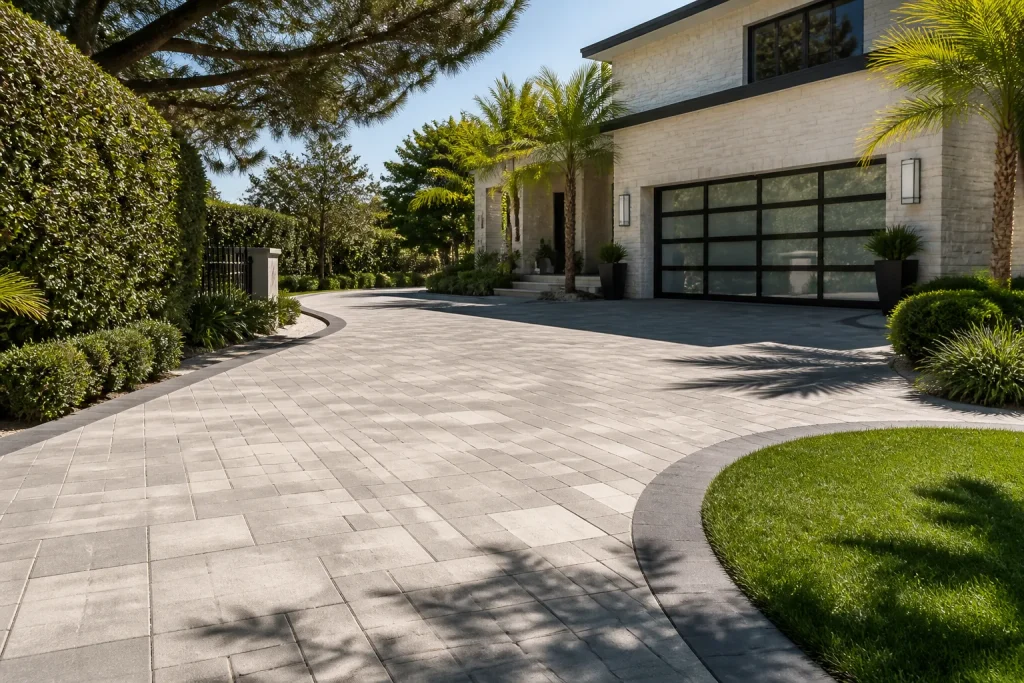
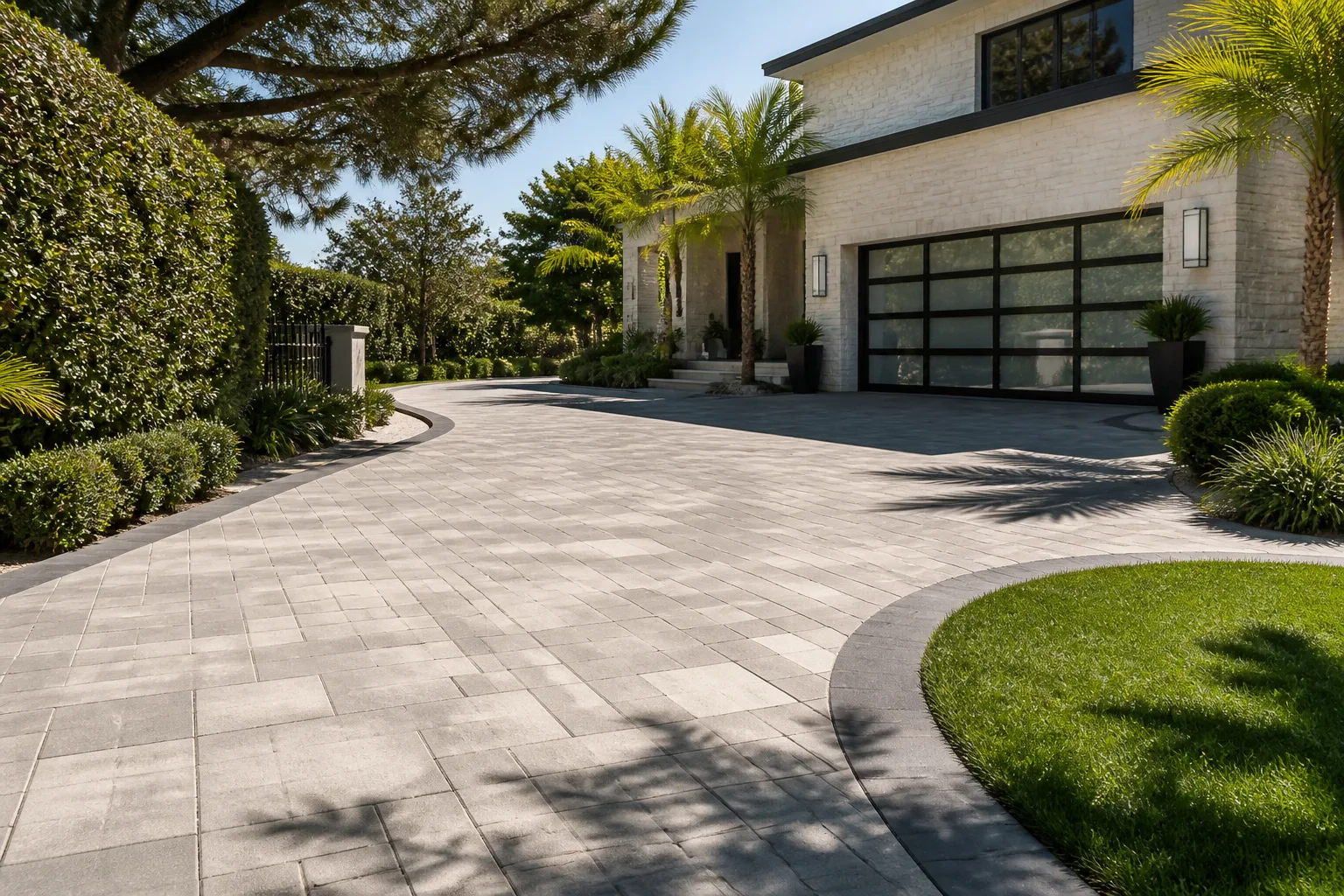
- Driveway border accents. A band of Caesarstone set flush along the edge of a paver drive gives you the polished-quartz look without putting it where tires roll. Pair it with a dedicated paver from a brand like Belgard for the drive field.
- Entry surrounds and porch treads. A covered front entry is the safest outdoor home for any quartz surface. It stays shaded, supported, and away from vehicle loads.
- Walkway inlays. A Caesarstone inlay in a concrete walkway, fully supported and pitched for drainage, handles foot traffic fine.
- Address-number plaques and planter caps. Small, decorative, supported, and shielded. This is where the material shines outdoors.
We pulled a Caesarstone bench cap off a front entry in Pasadena recently that had held up beautifully for years in a shaded courtyard. Same material in a sun-baked driveway would have told a very different story.
Caesarstone Warranty vs. Paver Warranties: Read the Language
This is where homeowners get caught. Caesarstone’s residential warranty is written for interior countertop installations, and it typically excludes damage from outdoor exposure, structural movement, and loads the material wasn’t designed to carry. Read the fine print before you sign anything, and ask for it in writing.
Purpose-built concrete pavers are manufactured for vehicular use, and their product warranties reflect that. Brands like Belgard publish outdoor-vehicular warranties that cover the application a driveway actually is. Two different materials, two different warranty scopes, and one is a match for your project.
Groundwork Construction Co. of Los Angeles stands behind every paver installation with the 730-Day Done Right Promise: if it’s not done right, we make it right. That covers the workmanship, and it’s one of the longest workmanship guarantees you’ll find in residential construction. Pair that with a product warranty written for driveways, and you have real coverage instead of fine print.
What to Ask a Contractor Proposing Caesarstone for a Driveway
If a contractor quotes Caesarstone for a full drive surface, ask these before you sign. The answers will tell you everything.
- “What is the substrate?” A proper concrete paver installation runs 4 to 6 inches of compacted class II base, plus edge restraint. If they can’t describe it in detail, walk.
- “Show me the manufacturer’s warranty for vehicular use.” Not the countertop warranty. The one that covers a driveway. If it doesn’t exist, the material isn’t made for the job.
- “How will this handle thermal expansion in the Valley?” A real answer references joints, movement accommodation, and base prep. A vague answer references “quality material.”
- “Will you pull the permits?” Driveway work often needs a permit, and a contractor who scoffs at that is telling you something.
- “Is the price fixed?” Upfront pricing, no surprises. The number they quote should be the number you pay.
If any of those answers wobble, get a second opinion. A drive is a long-term commitment.
When to Call a Pro
Driveway work involves excavation, base compaction, drainage grading, and load math. Getting it wrong shows up two seasons later as settling, ponding water, or cracking, and by then you’ve paid twice. Our technicians have up to 12 years of experience on projects like these, and every job comes with background-checked, uniformed technicians and a live person on the phone 24/7 if you have a question mid-project.
Related services in Los Angeles: see our Driveway & Pavers in Los Angeles page for material options and installation detail, and if your project touches the property line, our Fence Installation in Los Angeles team can align the two.
The Bottom Line
Caesarstone is a superb countertop material and a poor driveway material. Use it where it belongs, in borders, entries, and walkway details, and let purpose-built pavers carry the cars. You get the premium look and the durability you’re paying for.
If you’re in Los Angeles and need help sorting out driveway materials, Groundwork Construction Co. of Los Angeles offers free estimates. Call (888) 427-1733, and you’ll reach a live person, any hour of the day. We also offer 0% financing for 18 months and $1,000 off projects over $10,000, so a driveway upgrade doesn’t have to wait. When you’re ready for the bigger picture, our Groundwork Construction Co. of Los Angeles home page covers every service line, and our Home Additions & ADU in Los Angeles team handles projects that expand the footprint around your new drive.
Frequently Asked Questions
No. Caesarstone is engineered quartz made for interior countertops, and it isn’t manufactured or warranted for vehicle loads, direct UV, or the thermal and seismic movement Los Angeles driveways experience. Use purpose-built pavers for the drive surface and Caesarstone only in supported, shaded border or entry details. Call (888) 427-1733 for a free estimate on the right material.
Most concrete paver driveways in Los Angeles run roughly $12 to $20 per square foot installed, depending on base depth, drainage, and paver selection. Decorative border accents and entry details add to the total. Call (888) 427-1733 for a written, line-item estimate on your specific drive.
It can. Hairline cracking often appears at joints within a couple of seasons under tire loads, and edges can spall where slabs meet the base. The resin binder is also UV-sensitive and rigid, so it doesn’t flex with ground movement the way segmented pavers do.
Covered entry surrounds, porch treads, walkway inlays, and driveway border accents where the material stays supported and shaded. Pair Caesarstone detail work with a dedicated paver drive from a brand like Belgard, and you get both looks and durability. Call (888) 427-1733 to plan the mix.
Written by the team at Groundwork Construction Co. of Los Angeles.
Need Construction Help?
Call Groundwork Construction Co. of Los Angeles - licensed & insured, here with fast after-hours help in Los Angeles.
(888) 427-1733